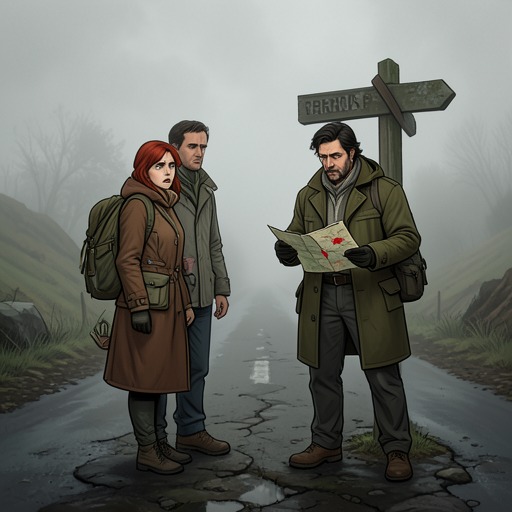
Lady Glynis Wright
The Tale of the Vampire BrideLady Glynis Wright is the central consciousness of the novel and the author of The Journal of Lady Glynis Wright. Introduced on 4 August 1819 during her family’s journey through the Carpathian Mountains, she is at once an English aristocratic daughter, an observant diarist, and a young woman already resisting the restrictions attached to her sex. Her encounter with Vlad Dracula begins a transformation that is physical, spiritual, social, and political: Glynis is made into a vampire, bound to Dracula as a bride and servant, and forced to negotiate a new existence in which hunger and supernatural power continually threaten the moral identity she struggles to preserve.
Identity and Early Character
Glynis first presents herself through intimate journal writing, addressing her diary as her only friend and promising to continue until her story in the castle has been fully told. This framing makes her not merely the subject of the narrative but its principal witness and interpreter. Her account is shaped by isolation: the diary becomes the private space in which she can name experiences that the castle’s hierarchy otherwise controls.
Her physical description emphasizes a mixed English and Italian heritage. She has her Italian mother’s light olive complexion and her British father’s red hair, along with aquamarine eyes, a Roman nose, and a rosebud mouth. The combination makes her visibly distinct, and the narrative repeatedly turns that distinctiveness into an object of supernatural and erotic attention. Yet her earliest image is not one of vanity. As the family carriage passes through the Carpathian Mountains, dread overwhelms her, and she seeks reassurance by placing her gloved hand beneath her father’s hand. His gentle gesture briefly establishes family tenderness against the brutal majesty of the landscape.
Glynis’s resistance to conventional femininity is explicit before her transformation. In conversation with May Wright, she rejects the accusation that she wants to become a wanton woman and instead declares that she wants to live as a woman who can act like a man, without the constraints imposed on women. Her complaint is directed at the unequal freedoms granted to men and denied to women. The statement becomes a foundation for her later conflict: the supernatural world appears to offer power beyond ordinary feminine restriction, but Dracula’s system replaces one form of confinement with another.
Arrival and Transformation
At Dracula’s castle, Glynis becomes the focus of Vlad Dracula’s attention almost immediately. When he approaches the carriage, his green eyes fix directly upon her, and he addresses her as Lady Glynis before introducing himself as Dracula. She feels the pressure of his power as an aura and shivers beneath his gaze. The meeting therefore functions as more than a formal welcome. It establishes a predatory relation in which recognition is inseparable from possession.
The threat becomes visually unmistakable when Prince Vlad emerges from the castle surrounded by armed gypsy guards. His long black coat, auburn curls, unearthly pallor, catlike green eyes, cruel smile, and two elongated teeth mark him as a figure of dark power. Glynis feels unseen forces drawing her gaze toward him, and her instinct is to grip her father’s arm. Her family’s vulnerability and Vlad’s fascination with her are placed in the same frame.
Her vampire birth is violent and psychologically disorienting. Madness overwhelms her senses, delusions take hold, and her screams continue for hours while her body transforms. The change is not represented as a graceful initiation into an alluring new life; it is an assault on bodily continuity and consciousness. She emerges as a creature whose beauty and power are inseparable from rage, confusion, and captivity.
The transformation also destroys her relationship with her mother, Antoinetta Wright. Before Glynis feeds, her mother buries her rosary in the dirt and straw, genuflects, kisses the object tenderly, and promises to pray before the Father, the Son, and the Holy Spirit and to ask the Blessed Virgin to watch over her daughter’s soul. She then urges Glynis to drink and live while repeating Glynis’s promise to escape. The scene places Christian devotion beside the impending blood rite: the rosary is hidden in the ground, while blood becomes the means by which Glynis is sustained and remade.
Antoinetta’s sacrifice is both maternal and tragic. She gives Glynis permission to live within the condition that has been imposed upon her, but she does so while insisting that Glynis must not forget her family or abandon the promise of freedom. Glynis answers that she will remember her mother, father, and May even if she lives until the world dies. The promise becomes one of the lasting ethical pressures on her later conduct.
Captivity, Clothing, and the Struggle for Agency
After her transformation, Glynis experiences the castle as a system of rules rather than a home. She describes the madness of her first birth as gone, only to discover the torment of sanity: her former life has become a distant memory, while her present life consists of the castle, hunger, obedience, and the need to survive until escape becomes possible. She understands herself as a slave to Vlad Dracula, and the language of the vampire bride is therefore inseparable from the language of enslavement.
Clothing makes that domination visible. Elina forces her away from her own garments, while Glynis resents the outfit chosen for her, which she believes makes her look like a Middle Eastern prostitute. She sees the change as another version of the social confinement she had resisted in human life: she has escaped one restrictive society only to become trapped in another. Her body is beautified, eroticized, and costumed, but none of those conditions gives her control over herself.
Glynis briefly reclaims a small measure of agency when she takes her favorite blue Italian-silk gown from her chest, removes the gauzy clothing imposed upon her, and dresses without a corset. The act is practical as well as symbolic. Her own clothing restores a connection to her former identity and allows her to feel physically more comfortable, even while Elina insists that Vlad is calling for her. The scene makes dress a political language: the garment imposed by the castle identifies her as a controlled bride, whereas the gown she chooses asserts continuity with the woman who existed before Dracula.
Her relation to hunger complicates any simple opposition between innocent victim and liberated monster. Glynis regards the gypsy girl who stole her ring as her first kill, even though Antoinetta’s death was forced upon her. She remembers enjoying the hunt and the rush of power produced by feeding. That pleasure disturbs her because it suggests that vampirism does not merely imprison her; it also reveals capacities she cannot honestly deny.
The contradiction reaches its crisis when Vlad restores her through a blood-filled ritual. The vampires gather around her, her sisters support her, and Vlad repeatedly dips a goblet so that she can swallow its contents. Afterward he lowers her into the blood as the others dance, while her wounds fade and her senses sharpen. Her heart begins to beat again, and the blood renews her vampire heritage. The immediate consequence is physical recovery, but the moral consequence is devastating: once the hunger recedes, Glynis recognizes that she has feasted on innocents in the arms of her captor. She understands that she has become the monster Vlad promised she would become.
Dracula’s Bride and the Politics of Visibility
Vlad’s control over Glynis is organized through both supernatural obedience and social presentation. He tells her that the power of the beckoning now belongs to their relationship: whenever he calls, she must come. He promises that Buda will provide freedoms unavailable in the castle, including the opportunity to hunt alone and learn the powers of the night, but the promise is conditional upon loyalty. He expects her to rise into the position of his true bride and identifies her as his intended first bride when they eventually establish themselves in England.
The journey to Buda therefore resembles liberation while functioning as a relocation of captivity. Vlad orders Glynis not to take dresses, jewelry, or any other possessions her brother might recognize. Instead, she is to wear dresses bought by her mother in Paris and jewelry belonging to Erzsébet Dolingen. The instructions erase evidence of her former self and replace it with a carefully designed identity that supports Vlad’s false account of the family’s fate.
The veil becomes the clearest emblem of this manipulation. At the Dracula Estate in Buda, Vlad has a dressmaker create special veils to conceal Glynis’s supernatural beauty from Andrew Wright, and he commands her to wear one whenever she is near her brother. Glynis finds the organza and lace heavy and irritating because the veil prevents her from truly seeing Andrew even while it conceals her from him. Finally, she tears it from her face and throws it onto the bed. The gesture is a moment of refusal, but it also reveals how completely her appearance has become a contested territory between Dracula’s authority, her family’s recognition, and her own desire to be seen on her terms.
At the opera, however, she is displayed in the role Vlad has prepared. She descends the stairs in an elaborate black-and-gold dress to meet Andrew and the man who claims to be her husband. Glynis notices the contrast between Andrew’s living goodness and Vlad’s dark, menacing atmosphere, yet she also recognizes the handsome appearance of both men in formal dress. For one evening the gown allows her to feel radiant and alive rather than undead. She experiences herself as every inch the Countess Dracula, but the title is double-edged: it offers grandeur while confirming the marital and supernatural identity Vlad has imposed upon her.
Relationships, Faith, and Purgatory
Glynis’s family remains the moral counterweight to Dracula’s household. Her father’s tenderness during the carriage journey represents a form of affection without possession, while Antoinetta’s final prayer and sacrifice preserve a language of love that Dracula’s blood bond cannot fully extinguish. May Wright’s earlier conversation with Glynis also establishes their shared awareness of gender restrictions and the intimate sisterly space in which Glynis can articulate her anger at social inequality.
Her bond with Andrew becomes especially dangerous because recognition itself threatens Dracula’s carefully constructed deception. Vlad wants Glynis hidden behind a veil and dressed in unrecognizable garments, while Glynis longs to see her brother and fears that Andrew may be placed in danger by Vlad’s temper. Family reunion is thus inseparable from concealment, surveillance, and the possibility of betrayal.
Glynis’s story also intersects with Ignatius’s crisis of faith. In the place its proprietor calls Purgatory, Ignatius explains that he can no longer touch his crucifix, enter his church, or feel God’s presence. He serves the vampire woman who made him and her husband, loves them both, and treats his continued service as a penance undertaken in the hope of salvation. His confession gives Glynis a parallel image of damnation: vampirism is not only physical hunger but separation from sacred belonging and a condition interpreted through service, lust, and guilt.
Ignatius’s love for Glynis intensifies rather than resolves her predicament. He says that seeing her awakened a love unlike any he had known, and he fears losing her to Astir’s prophecies. Glynis, however, believes that Astir’s prediction will come true even though she does not yet understand how. She recognizes the terrible possibility that she will destroy the one who loves her. This foreknowledge places her between affection and catastrophe, making intimacy another arena in which her inherited or imposed power threatens to become destructive.
Change, Conflict, and Narrative Significance
Glynis’s development is not a clean passage from human innocence to supernatural mastery. It is a sequence of forced births, partial refusals, relapses into hunger, and attempts to recover authorship over a body and name controlled by others. The diary preserves these contradictions instead of resolving them. Glynis can condemn her own monstrosity while admitting the exhilaration of the hunt; she can hate the bride’s costume while feeling radiant in the title of Countess Dracula; she can long for freedom while acknowledging the power that blood gives her.
Her central conflict is therefore not simply whether she will escape Dracula’s castle. It is whether escape can mean more than movement from one enclosure to another. The castle confines her through commands, clothing, hunger, and the beckoning. Buda offers a more elaborate stage for concealment, where veils, borrowed jewels, and the public role of wife protect Dracula’s plans. Even apparent elevation into a favored bride remains a form of possession.
The novel’s religious imagery sharpens this struggle. Antoinetta’s rosary, her prayers for mercy, the priest’s crucifix during the villagers’ assault, and Ignatius’s lost access to church and divine presence all establish a sacred order from which vampirism is excluded. Against it stands the blood ritual in which Vlad and the other vampires surround Glynis, feed her, immerse her, and restore her senses. The scene resembles an inverted baptism or sacrament: blood grants renewal, but its gift carries guilt, dependence, and the recognition that survival has required the destruction of innocents.
Glynis’s decisive significance lies in her refusal to become legible through only one of the identities imposed upon her. She is daughter, sister, diarist, vampire, bride, countess, captive, lover, and potential destroyer. Each role is attached to a different form of power, and each threatens to eclipse the others. Her journal is the place where those competing identities remain in argument. Rather than presenting vampirism as a simple supernatural condition, her narrative makes it a struggle over who may name her body, determine her clothing, command her movement, interpret her soul, and decide what kind of freedom remains possible.